|
Broad Ripple Random Ripplings


The news from Broad Ripple
Brought to you by The Broad Ripple Gazette
(Delivering the news since 2004, every two weeks)

|
| Brought to you by: |

|

|
|


|

|

|
Converted from paper version of the Broad Ripple Gazette (v06n15)
Indiana School for the Blind history - part seven
posted: Jul. 24, 2009
Philadelphia financier James McCrea and Pennsylvania Company President Frank Thompson asked McGowan to represent their financial interests in the Citizens' Company that operated street cars in Indianapolis in 1899. Service was poor under local management. Fares were three cents. McGowan organized a syndicate to buy the Citizens' property and franchise. He also sought and received necessary legislation and city officials' cooperation within a month. The Indianapolis Street Car Company was born and operated by the Indianapolis Traction and Terminal Company. Service improved and fares were reduced. McGowan moved to Indianapolis with Kate (they married February 9, 1887) and had four daughters, Marjory, Louise, Isabel and Frances.
The Indianapolis Traction and Terminal station in Downtown Indianapolis.
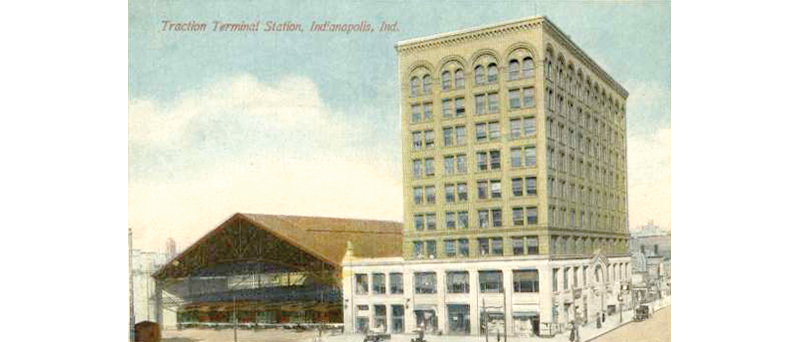
Within a year, he merged 125 miles of street railways into one system with about $15 million in capital. He later bought and merged interurban roads around the state into ITTC, making him a millionaire.
Asked the secret of his success, McGowan replied, "Do everything you do, no matter how humble the task as well as you possibly can. You will thus attract the attention and commendation of your superiors. Whether I was a hostler in street cars, currying mules or working as a policeman, I did my best." Hard work was his hobby.
McGowan often spent weekend afternoons in Broad Ripple Park with his family. They also traveled to Europe three consecutive summers around 1908-1910.
Not only a captain of industry, but also a prolific philanthropist, McGowan provided St. Peter and Paul's Cathedral with their organ and financially assisted in its construction. He was also involved in the building of St. Vincent's Hospital, Little Sisters of the Poor, the Good Shepard and the Young Men's Christian Association.
McGowan's primary residence was at 1305 North Delaware Street. Also, he purchased land at 7500 North College Avenue which had interurban tracks on the property's western edge. The Lilly family's apple orchard was south of his property where Park Tudor School is now located.
According to a topographical map created by Jeup & Moore Engineers from October of 1906, McGowan planned to build a home, flower garden and horse barns on the estate that eventually became ISB's new location. His untimely death from an "acute cardiac dilatation of the heart" on December 19, 1911 at age 54 altered history.
The advent of the Model T Ford gradually influenced travel preferences and interurbans eventually ceased operations.
In 1919, McGowan's two companies merged as Indianapolis Street Railway Company. After 1920, this was owned by the Terre Haute, Indianapolis & Eastern Railroad. The company began operating buses in 1923 and bought the rival Peoples Motor Coach Company in 1927, according to Elizabeth Wishard.
When Kate McGowan signed the property deed over to the State of Indiana, the land became prime real estate for development. Though their family had no direct link to ISB, their legacy followed their philosophy of philanthropy. Had Hugh McGowan lived, the school's location and history might be far different than it is today.
Hugh J. McGowan's cousin, Joseph A. McGowan, was also associated with the Indianapolis Traction and Terminal Company. Joseph's grandson, William K. McGowan Jr., is the former President and CEO of the Indianapolis Convention & Visitor Association. He recently shared some memories: "As a boy, I remember my father and me visiting Cousin Hugh's widow, 'Cousin Kate,' at her apartment in the 1300 block of North Meridian Street. She moved from their Victorian-style home after Hugh died," he recalled.
"My wife, Joan, and I visited Hugh and Kate's former home at 1301 North Delaware Street, which was used by the Knights of Columbus in the late 1950s and early 1960s. There was a beautiful ballroom on the third floor, a wood-paneled library and lots of space that the K of C used as their Indianapolis clubhouse. Unfortunately, the home was razed in 1963," he explained.
William K. McGowan Jr., is a Cathedral High School graduate who earned his business degree from the University of Notre Dame. Joan is a Broad Ripple High School graduate who earned her microbiology degree from Miami University in Oxford, Ohio. She was a microbiologist at Eli Lilly & Company whose career included basic research on the drug Keflex. They have been actively involved in the Indianapolis community for many years.
Unique for its nature-like setting, ISB's new location at 7500 North College Avenue warrants further description that will appear in the next installment of this series.
mario@broadripplegazette.com
|
|
|
|
| Brought to you by: |
|
|
|
| Brought to you by: |
|
|

|
|

