|
Broad Ripple Random Ripplings


The news from Broad Ripple
Brought to you by The Broad Ripple Gazette
(Delivering the news since 2004, every two weeks)

|
| Brought to you by: |

|

|

|


|

|

|
Converted from paper version of the Broad Ripple Gazette (v06n10)
Indiana School for the Blind history - part four
posted: May 15, 2009
The inaugural convention held in 1853 did not address a uniform printing system of Braille materials. There were at least eight different types of printing systems and convention delegates were challenged to agree on one method. Eventually, "a set of symbols equally adapted to print and writing by hand" were utilized, wrote Elizabeth Wishard.
In addition to improved books and school materials, Churchman recommended various capital improvement projects in 1872. They included extending the heating plant to include workshops, refinishing the main building exterior, connecting the school's sewers to city sewers and to city water mains, obtaining softer water and reducing the manual labor of pumping by hand into a reservoir.
William Churchman memorial booklet published in 1918.
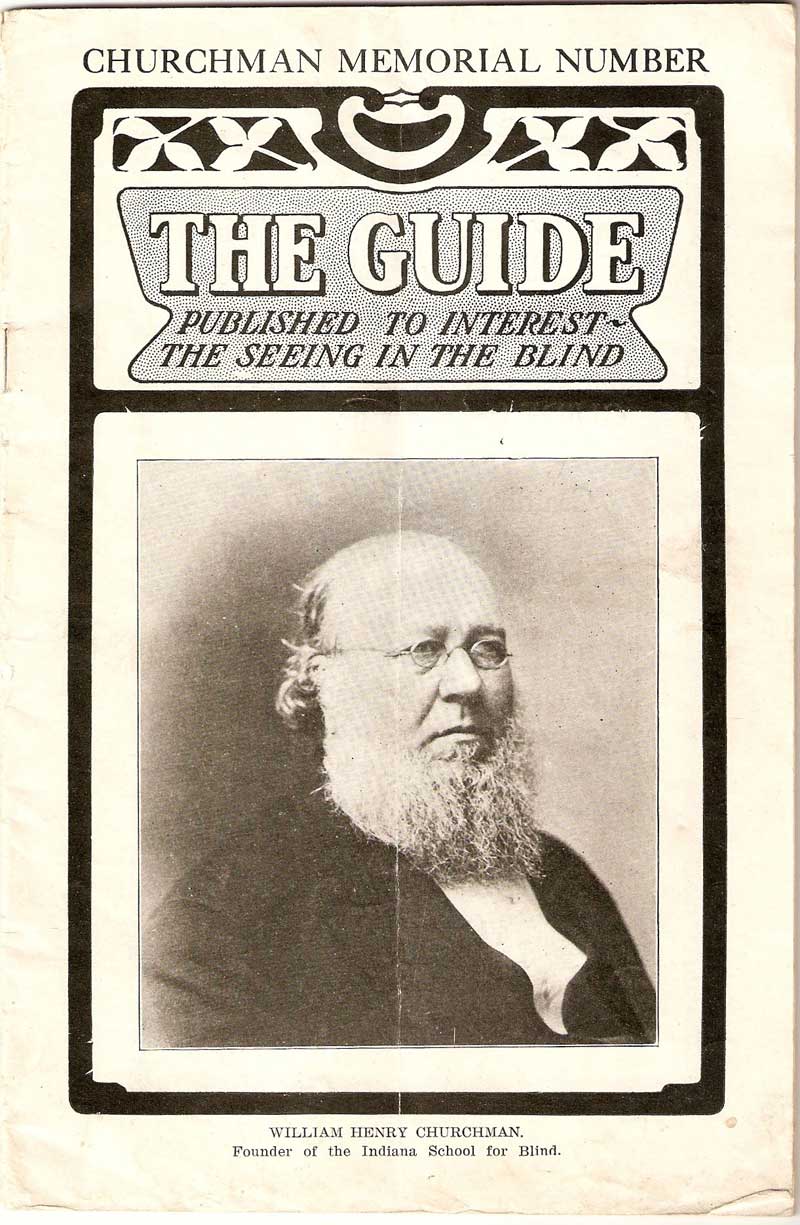
image courtesy of Carol Churchman Oakes
The legislature again neglected to provide financial appropriations as the school operated on a monthly state allowance. Trustees considered selling the northern half of the campus grounds for extra funds. Even though this existing area was converted into St. Clair Park, it remained part of school property. Despite his recommended capital projects going unrealized during his second term, Churchman was satisfied with the school's overall progress.
An 1873 United States Census counted 991 blind individuals in Indiana of which Churchman estimated 25 percent to be of school age. He believed the school could potentially educate 200 to 300 students as enrollment reached 123 pupils in 1879.
That same year, a brick stable was built for $2,200 to house three horses, six cows and their caretaker. It contained a loft, carriage room, feed, harness and washrooms. There was a strong objection to boys and girls residing in the same building, though they were segregated.
Churchman's achievements during his second tenure from 1861-1879 easily eclipsed those of his first, permanently establishing his place in the school's history. Elizabeth Wishard wrote, "After his resignation in May of 1879, he lived the remainder of his life with his half brother, whose home was six miles southeast of the city. He died on May 17, 1882. His funeral services were held in the school's chapel, but there was no mention of his death in the Indianapolis newspapers." A bronze plaque honoring William H. Churchman can be seen inside the school's main entry today.
Carol Churchman Bales is the great great niece of William H. Churchman, who described her great great uncle: "He was a serious student in school. He strained his eyes from studying and became blind as a result and that seemed to increase his determination. He went on and completed his education. He had been superintendent in several schools for the blind. He personally supervised all the construction of the school on Pennsylvania, climbing on the scaffolding and ladders to check the work. He was very close to his students and they respected and admired him. My great grandfather, Francis M. Churchman, came to Indianapolis to help him," she explained.
Francis M. Churchman was born in Wilmington, Delaware. When he arrived in Indianapolis at the age of 14, he had less than three years of education. He not only helped his brother William, but he also became a messenger and sweep out boy for some of the merchants that included the private banking house of Stoughton Fletcher, who owned the Fletcher Trust Company. This would later become American Fletcher National Bank (now Chase).
"During these years, by studying and reading every night, Francis improved his education enough to become a clerk in Fletcher's Bank. He worked his way up and eventually became managing partner of that bank. He married Mary Marshall, who came to visit a person in the school one day He was involved in the construction of Churchman Avenue which was a toll road then; he also installed the fountain in Fountain Square to water his horses on the way to work," she noted. Francis married one of their two adopted daughters.
Bales' father, Frank L. Churchman, wrote a book, "So this was Hillside" about the Churchman family in the 1980s, which is located on the southeast side of town where they lived.
Finances historically played a significant role in school operations and proposed expansion. An 1879 report listed the following monthly wages: superintendent clerk, $13; watchman, $5; fireman, $17; porter, $17; cook, $18, while maids were paid $10.
mario@broadripplegazette.com
|
|
|
|
| Brought to you by: |

|
|
|
| Brought to you by: |
|
|

|
|

